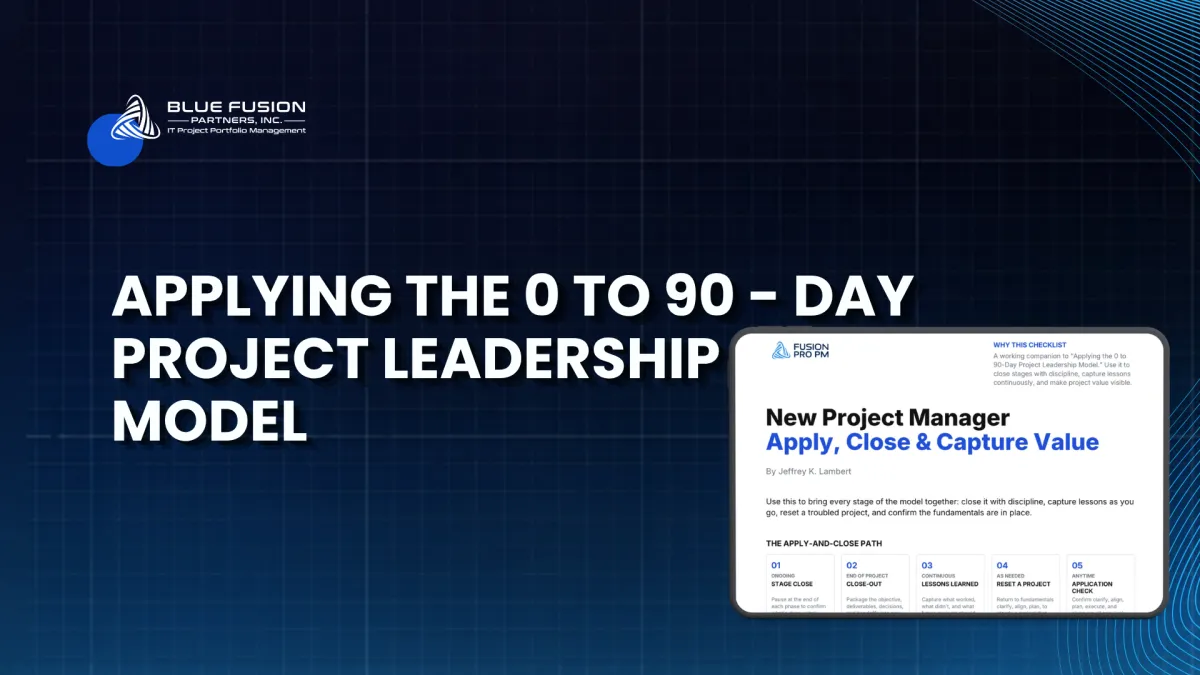
Applying the 0 to 90-Day Project Leadership Model
Bring the stages together, close each phase with discipline,
and make project value visible
The first 90 days of project leadership are not about becoming a perfect project manager. They are about building a practical delivery system that helps the team clarify the work, align the right people, plan realistically, execute with control, and close with discipline.
For new project managers, functional leaders, and professionals who have inherited project responsibility, the early months can feel uncertain. You may be learning the organization, meeting stakeholders, navigating competing priorities, and trying to understand what people expect from you.
It is easy to believe your job is to have every answer immediately. That is not the job. The 0 to 90-day model gives you a manageable way to lead. You do not have to fix everything at once. You need to know what to focus on first, what to build next, and how to keep the project moving without losing control.
How the 0 to 90-day model fits together
The model works because it follows the natural progression of project leadership: clarify the work, align the people, build the plan, execute with control, and close the work in a way that captures value.
Each part of the series has a distinct purpose:
Days 0 to 30 - Clarify and align: Build a usable foundation around project purpose, scope boundaries, stakeholders, governance, assumptions, risks, and the charter or project brief.
Days 31 to 60 - Continue alignment and plan: Build a realistic delivery structure around milestones, dependencies, ownership, communications, RAID, change control, budget, vendors, OCM work, and Agile or sprint planning where applicable.
Days 61 to 90 - Execute with control: Establish a disciplined operating rhythm for task execution, status cadence, stakeholder communication, scope control, risk response, vendor follow-up, financial visibility, OCM coordination, and deliverable acceptance.
Ongoing - Apply, close, and capture value: Use stage close, project close-out, lessons learned, handoffs, business impact, and repeatable delivery habits to keep improving.
This mirrors the FusionPro PM lifecycle: clarify, align, plan, execute, and close. The lifecycle is not just theory. It is a way to prevent confusion, make decisions visible, and keep project work connected to business outcomes.
Use the model across traditional, Agile, and hybrid projects
The 0 to 90-day model is not limited to one methodology. A construction-style schedule, a software implementation, a process improvement effort, a client onboarding project, a marketing launch, or an Agile product delivery effort may all use different tools. They still need the same management logic.
In a traditional project, the team may work from a project schedule, work breakdown structure, milestone plan, dependency map, and formal approval checkpoints. In Agile or iterative software delivery, the work may be organized through a product backlog, sprint planning, sprint reviews, demos, releases, and changing priorities.
The format changes. The fundamentals do not.
A project manager does not need to take over backlog grooming, sprint planning, or development-team ceremonies. Those activities normally belong with the product owner, product manager, scrum master, technical lead, and delivery team. The project manager should understand how that work connects to the broader project: governance, stakeholder communication, release commitments, risk, funding, vendor coordination, business readiness, and organizational change impact.
For hybrid projects, this connection is especially important. A team may use sprints to build software while the broader initiative still depends on procurement, legal review, training, data migration, compliance approval, executive decisions, communications, and operational readiness. Agile delivery does not remove the need for project control. It makes the control points more important because decisions and learning happen continuously.
Close stages before you rush into the next one
Stage close is the discipline of pausing at the end of a meaningful phase to confirm what was completed, what changed, what remains open, and what should carry forward.
This does not need to become bureaucracy. It can be a short checkpoint at the end of clarity and alignment, planning, execution of a milestone, a sprint, a release, a pilot, a testing cycle, a go-live, or a major workstream. The purpose is to prevent loose ends from following the project into the next phase.
A stage-close checkpoint should answer:
What did we complete?
What was approved, accepted, or deferred?
What changed from the prior baseline?
What risks, issues, assumptions, or dependencies remain open?
What decisions were made, and where are they recorded?
What OCM, readiness, training, support, or adoption items must carry forward?
What financial, vendor, or resource items need attention?
What must be true before the next stage begins?
Without stage close, projects accumulate unmanaged residue. Decisions get forgotten. Assumptions resurface. Deliverables are treated as complete before they are accepted. Risks move forward without owners. Teams enter the next stage without a shared understanding of what changed.
Stage close maintains the integrity of the project record so decisions, risks, handoffs, and lessons remain visible as the work moves forward.
Close the project as part of delivery
Project close-out is not an administrative afterthought. It is part of successful delivery.
A project can complete the technical work and still fail to capture business value, lessons learned, operational handoff, or adoption needs. That is why close-out should be planned before people move on to the next priority.
A basic close-out package should include:
Original objective and approved scope
Delivered scope, major deliverables, and acceptance status
Success criteria, actual results, and business impact
Open items, deferred scope, or future-phase recommendations (RAID Log)
Key decisions made and where the decision log is stored (RAID Log)
Risks and issues resolved, transferred, or still requiring ownership (RAID Log)
Final budget, cost summary, or financial notes where applicable
Vendor close-out items, contract notes, invoices, or service handoffs where applicable
OCM, readiness, training, support, and adoption outcomes where applicable
Team contributions and stakeholder acknowledgments
Artifacts created and where they are stored (Single Safe Source)
Lessons learned and recommendations for the next project
Formal sign-off or sponsor acceptance where required
Handoff to operations, support, business owner, or product owner (Hypercare Log, Run Book)
This does not need to be a massive binder. It should be a clear record of what the project accomplished, what value was created, what remains open, and who owns the work after the project ends.
For new project managers, close-out also builds professional credibility. It shows that you understand delivery is not only activity. It is outcomes, accountability, learning, and continuity.
Make lessons learned continuous, not ceremonial
Many teams wait until the end of the project to ask what they learned. By then, people are tired, details are lost, and the next project has already started.
A stronger practice is to capture lessons throughout the project. Keep a running lessons-learned note as risks appear, decisions change, assumptions prove wrong, stakeholder concerns surface, vendor handoffs slip, or adoption issues emerge.
At stage close or project close-out, organize those observations into three simple categories:
What worked well and should be repeated?
What did not work and should be changed?
What did we learn that future projects should know earlier?
This is especially useful in Agile and iterative delivery. Sprint retrospectives may identify team-level improvements, while project-level lessons should also capture governance, stakeholder, vendor, budget, release, OCM, and business-readiness insights. Both views matter. One improves the delivery team. The other improves the delivery system.
Use the model to reset troubled projects
This series is written for the first 90 days of a new project manager, but the same logic also works when a project is already in trouble.
If a project feels chaotic, do not start by adding more meetings or chasing every symptom. Return to the sequence:
Clarify the objective and success criteria.
Reconfirm scope and out-of-scope boundaries.
Re-map project stakeholders, decision rights, and governance forums.
Separate project governance stakeholders from OCM-impact stakeholders.
Rebuild the milestone plan or backlog-to-release view.
Recheck dependencies, resource assumptions, vendor commitments, and financial constraints.
Reestablish the status rhythm, RAID log, decision log, and escalation path.
Confirm OCM, readiness, training, communication, and adoption support where the project affects people.
Close open decisions, deliverables, and risks before they keep multiplying.
A reset does not always require a new methodology. Often, it requires returning to fundamentals that were skipped, rushed, or never documented. The 0 to 90-day model gives new and developing project managers a practical way to find those gaps without turning the recovery effort into a second project.
Common mistakes to avoid
The first mistake is treating the 0 to 90-day model as a rigid calendar. Some projects move faster. Some move slower. Some require urgent execution before every detail is clear. The timeline is a guide, not a cage. The sequence matters more than the exact day count: clarify before planning, align before assigning, plan before committing, execute with visibility, and close with discipline.
The second mistake is confusing documentation with control. A charter, schedule, backlog, RAID log, decision log, communication model, or close-out summary only helps if it is used. The value is not the file. The value is shared understanding, decision clarity, and visibility.
The third mistake is allowing the project manager to become the owner of everything. Project managers coordinate work, surface risk, facilitate project meetings, track progress, and support delivery. They should not become the substitute for every decision owner, functional lead, vendor manager, finance partner, change lead, product owner, or business sponsor.
The fourth mistake is waiting too long to communicate bad news. Projects rarely improve because risk is hidden. They improve when reality is visible early enough for the right people to act.
A practical application checklist
When you are unsure where to focus, use this checkpoint:
Clarify: Can you explain the project purpose, outcome, scope, and success criteria in plain language?
Align: Do the sponsor, stakeholder committee, steering committee, project team, decision owners, and impacted groups understand their roles?
Plan: Do you have realistic milestones, dependencies, owners, risks, resource assumptions, budget inputs, vendor needs, and Agile or release-planning connections where applicable?
Execute: Are you using a regular rhythm for task execution, status, communications, scope, risks, issues, vendors, finances, OCM support, and deliverable acceptance?
Close: Are you capturing approvals, decisions, lessons, outcomes, handoffs, business impact, and open items before moving forward?
If any answer is no, that is where to focus next.
Final thought
You do not need to become an expert project manager in your first 90 days.
You need to practice the fundamentals with discipline.
Clarify the work. Align the people. Build a realistic plan. Execute with visibility. Adapt without losing governance. Support change and adoption work where the project affects people. Close stages and projects in a way that captures value.
That is how new project managers move from reacting to leading.
It is also how projects become less chaotic, more visible, and more controlled.
Take the next step
Use this four-part series as a practical field guide for your first project or your next project reset.
Start with the project brief. Build the stakeholder map. Confirm governance and ownership. Create the milestone plan or backlog-to-release view. Establish the status rhythm. Track risks, changes, decisions, finances, vendors, OCM activities, and deliverables. Then close the work properly so the value is not lost.
For additional support, use the FusionPro PM templates, checklists, AI prompt libraries, and coaching resources to turn these concepts into repeatable project habits.
Download the 0–90 Day Project Leadership Checklist
Ready to put the entire 0–90 day model into practice? Use the 0–90 Day Project Leadership Checklist as a practical field guide to help you clarify the project, align stakeholders, build the plan, execute with control, close stages, and capture project value.
Watch the Supporting Webinar
Want to go deeper into the fundamentals of taking on a new project? Watch “You’ve Been Handed a Project. Now What?” for practical guidance on getting started, understanding expectations, working with stakeholders, clarifying scope, and building a strong foundation for delivery.


