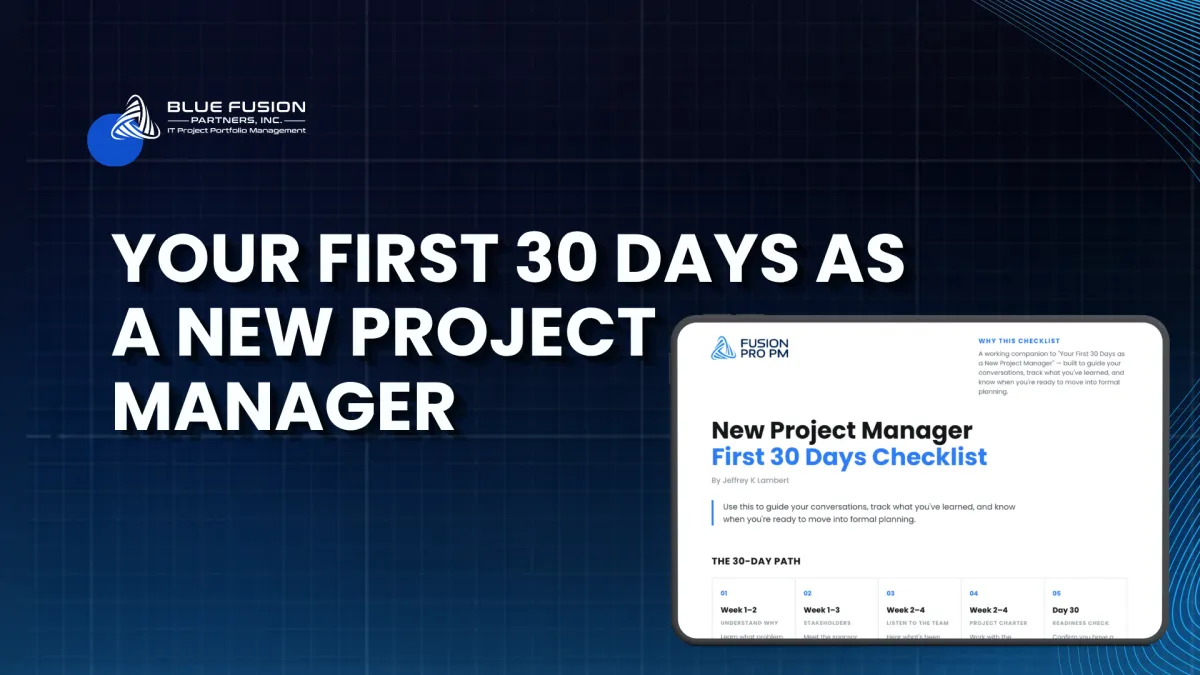
Your First 30 Days as a New Project Manager
Clarify the project, align the people, and build the foundation before planning begins
Starting your first project management role can feel like walking into the middle of a moving conversation.
People may already be talking about dates, tools, vendors, requirements, tasks, budgets, risks, and unresolved problems. Some stakeholders may believe the project is defined. Others may still disagree about what it should accomplish. The sponsor may expect order quickly, while the team may expect direction before the real foundation is clear.
That pressure can make a new project manager jump straight into scheduling.
Resist that urge.
Your first 30 days are not about proving that you can build a plan fast. They are about clarifying the project, aligning the right people, and creating a foundation that planning can stand on. Before you manage the work, you need to understand the purpose, outcomes, boundaries, assumptions, governance structure, and key decisions.
That is the difference between activity and project leadership.
Whether you are managing your first formal project, moving from a functional role into project leadership, or adding project responsibilities to your current job, the first month matters. You do not need every answer on Day One. You need enough clarity and alignment to move forward with confidence.
A useful mindset for the first month is this: you do not have to do all the work yourself. Your role is to help the right work get done by the right people. During Days 0-30, that begins with clarifying the project and aligning the people before detailed planning.
Start with the reason for the project
Every project needs a clear reason to exist.
Many new project managers start with tasks because tasks feel concrete. But tasks without context can quickly become noise. If you do not understand why the project matters, you will struggle to make good decisions when priorities conflict, resources are constrained, or scope pressure begins.
Start with the sponsor or project owner. Ask direct questions:
What problem or opportunity is this project addressing?
Why is this project important now?
What outcome is the organization hoping to achieve?
What would make this project successful?
The answers may already exist in a business case, leadership presentation, intake form, customer request, meeting notes, or funding request. They may also be scattered across informal conversations. Your job is to turn those fragments into a clear working summary.
This does not need to become a large document. A concise project brief is often enough. Define the purpose in plain language before the team invests heavily in planning.
A simple test is this: can you explain the project in one sentence?
If you cannot, the project is not ready for detailed planning.
Clarify scope before it becomes a fight
Scope confusion is one of the earliest ways a project starts drifting.
During the first month, clarify what the project includes, what it excludes, and where the gray areas are. Do not wait until planning or execution to discover that stakeholders have different expectations about deliverables, systems, timing, training, reporting, or support.
A practical scope conversation should answer:
What deliverables are expected?
What business outcomes are tied to those deliverables?
What is explicitly out of scope?
What items may belong in a future phase?
What assumptions are being made about timeline, budget, staffing, tools, or vendor support?
This is where a one-page scope statement or project brief becomes useful. It keeps the conversation grounded when someone later says, "while we are at it, can we also add..."
The goal is not to shut down good ideas. The goal is to prevent every good idea from becoming an unapproved project commitment.
Identify the right project stakeholders before the kickoff
Stakeholders are not only executives.
They include the people and groups who influence direction, approve decisions, provide resources, complete the work, use the final output, fund the effort, block progress, or are affected by the outcome. However, not every stakeholder belongs in the same project forum. One early PM responsibility is to understand the stakeholder landscape and organize it into the right governance structure.
Most projects operate with a three-tier model.
1. Strategic level
This is typically the stakeholder committee. It includes executive sponsors, senior leaders, and decision-makers who provide direction, approve major decisions, resolve escalated issues, and maintain business alignment.
2. Tactical level
This is typically the steering committee. It includes working managers, process owners, department leaders, and functional managers who guide the work, resolve cross-functional issues, validate priorities, and support execution alignment.
3. Operational level
This is the execution team, the "boots on the ground." It may include subject matter experts, functional leads, technical leads, analysts, vendors, implementation resources, and others responsible for completing the work.
In smaller companies or smaller initiatives, the steering committee and stakeholder committee may be combined. The structure must still be formal, and the decision paths, escalation routes, working responsibilities, and governance forums must be clearly defined.
During early stakeholder discovery, ask the sponsor who must be involved, who owns key decisions, who may have concerns, and who needs representation in the governance structure.
Useful sponsor questions include
What role does each stakeholder play in this project?
How is each stakeholder part of the decision structure?
What outcome matters most to each stakeholder?
What concerns does each stakeholder have?
What decisions does each stakeholder make, recommend, or influence?
Are there other stakeholders who should be identified before we move further?
These conversations help the project manager understand both the formal governance structure and the informal path by which work gets done. They also reduce confusion. People are more likely to support a project when they understand their role, forum, decision rights, and how their input will be used.
Separate project governance from OCM stakeholder discovery
Project governance and organizational change management both involve stakeholders, but they do not use the word in exactly the same way.
In project management, stakeholders are usually organized around decision-making, governance, funding, delivery, and execution. In organizational change management, the view is broader. It may include anyone who has influence, is impacted by the change, needs to adopt a new process, or must be communicated with during transition.
Those broader OCM stakeholders may participate in town halls, feedback sessions, training sessions, surveys, adoption discussions, or readiness activities. That does not mean they sit on the steering committee or stakeholder committee. The OCM lead is typically part of the operational project team and may also participate in steering committee or stakeholder meetings when adoption, readiness, communication, or business impact is discussed.
For OCM stakeholder discovery, expand beyond project governance. Look for impacted business groups, process owners, customer-facing teams, operational owners, end users, trainers, communications partners, compliance reviewers, and change-impact groups.
Practical OCM questions include:
Who will need to work differently because of this project?
Which teams need training, communication, or adoption support?
Who has informal influence with the impacted audience?
What forums, town halls, listening sessions, or feedback channels may be needed?
This distinction matters. Project management should define the formal governance structure. OCM should identify impacted audiences, adoption risks, and engagement needs. Together, they help the project move with both delivery control and change readiness.
Align roles and decision authority early
A project can look aligned in a meeting and still be unclear in practice.
The real test is whether people understand who owns the work, who makes decisions, who must be consulted, and who only needs to be informed.
You do not need a complicated governance model in the first month. You need a working view of ownership and decision authority. A basic RACI can help:
Responsible: Who does the work?
Accountable: Who makes the final decision? There should usually be one clear accountable owner for a major decision or deliverable.
Consulted: Whose input is needed before a decision is made?
Informed: Who needs updates but does not need to approve the work?
Use RACI as a conversation tool, not paperwork. Ask where ownership is unclear, where two people believe they both have final say, and where no one is willing to own a decision. Those are early governance risks.
If ownership is unclear, document it and work with the sponsor to resolve it before detailed planning.
Listen to the team already involved
The people closest to the work often see issues before anyone else does.
Meet with team members already involved or expected to contribute. Do not use those conversations only to assign work. Use them to learn what has been promised, what remains unclear, what has worked before, and where the project may run into trouble.
Useful questions include:
What do you understand this project to be?
What has already been decided?
What has already been promised?
What assumptions are people making?
Where do you see resource, timing, technical, vendor, process, or adoption risk?
What support would help the team move faster or avoid confusion?
You do not need to solve every concern immediately. Listening, asking follow-up questions, and documenting what you hear are valuable. These inputs should feed the charter, stakeholder map, assumptions list, initial risk log, and planning discussion.
Build the charter or project brief
The first 30 days should produce a usable project foundation.
In some organizations, that foundation is a formal project charter. In others, it may be a project brief, scope statement, intake document, Six Sigma 8-pack, or leadership-approved one-pager. The format can vary; the purpose should not.
The document should create a shared project definition before detailed planning begins.
At minimum, clarify:
The business need and project objective
Expected outcomes and success measures
Scope and major deliverables
What is explicitly out of scope
Key stakeholders and decision owners
Assumptions, constraints, and major risks
Known timing, budget, resource, and vendor expectations
Governance and escalation expectations
This is where many projects become manageable or chaotic. If success is unclear, scope boundaries are vague, stakeholders disagree, decision rights are unknown, or assumptions remain hidden, the project plan will rest on unstable ground.
A practical target for Day 30
By the end of the first month, aim to have a working foundation the sponsor and team can use.
You should be moving toward:
An approved charter or a defined path to approval
A clear project objective and success definition
A scope boundary with in-scope and out-of-scope items
A stakeholder map covering influence, impact, decision authority, and communication needs
An initial ownership model or RACI
A list of assumptions, constraints, risks, and open questions
An initial view of governance, escalation, and communication expectations
Enough vetted information to begin formal planning
This does not need to be perfect. It needs to be usable.
What comes next
Once the project is clarified and the key people are aligned, the next step is not simply "start doing the work." It is to continue alignment while turning the foundation into a practical plan.
That is the focus of Part 2: Days 31-60 - Continue Alignment and Build the Plan.
Download the First 30 Days Checklist
Ready to put these ideas into practice? Use the New Project Manager First 30 Days Checklist as a simple reference for the conversations, questions, and working documents that can help you clarify the project, align stakeholders, and build a strong foundation during your first month.
Watch the Supporting Webinar
Want more guidance on what to do when you are handed a new project? The webinar “You’ve Been Handed a Project. Now What?” provides practical guidance on getting started, working with stakeholders, clarifying scope, understanding project expectations, and organizing your first few weeks.


